Why a Roulette Layout Separates Inside and Outside Bets
Roulette layout inside and outside bets become easier to read when you see how each area groups a different kind of choice, not a forecast.
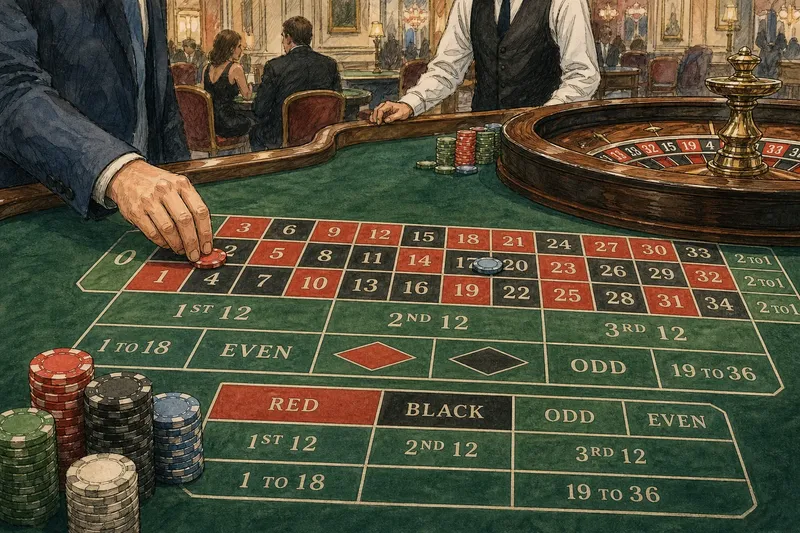
A roulette layout makes its two broad betting areas visible before a player has to choose: inside bets sit among the numbered pockets, while outside bets occupy marked bands around them. Understanding roulette layout inside and outside bets is a matter of reading that geography, not looking for a clue about where the ball will land. The arrangement groups choices by the numbers they cover and the way they are placed.
Here are six features that make the division easier to understand. They describe the layout as a system of labels and positions; neither region has a privileged view of the next result.
1. The numbered grid gives inside bets their name
The inside area is the grid of numbered cells, commonly set out in rows and columns beside a separate zero space. A player places a chip on a cell or across a boundary between cells. The chip’s position indicates which numbered pockets are included in that choice.
A chip centred on a single number is a straight-up bet. A chip placed on the line between two adjacent numbers is a split. Other placements can cover a row of three, a block of four, or a larger section of the grid, depending on the table’s markings and rules. The exact eligible placements vary by layout and game variant, so the printed felt and table rules are the relevant references.
This design makes the inside area a map of local combinations. Moving a chip a small distance can change the set of numbers it represents, which is why dealers and players pay close attention to the lines between cells. The layout is not marking a number as more likely. It is making the chosen coverage legible.
2. Outside bands group numbers by shared labels
Outside bets sit beyond the numbered grid, in boxes labelled with categories such as red or black, odd or even, and low or high. There are also dozen and column bets, which refer to groups of numbers rather than a single cell or a small neighbouring cluster.
These labels make broad choices easy to locate. Instead of placing a chip on one number or a small patch of the grid, a player chooses a named group. Red and black organise numbers by colour; odd and even use parity; low and high divide the numbered range according to the table’s convention. Dozens and columns use the grid’s structure.
Each label has exceptions in its coverage. Zero, and any additional pocket in a variant, may not belong to an even-money category such as red or odd. The layout and rules show how those exceptions work. The outside area is therefore a shorthand for membership in a defined group, not a promise that the group will appear.
3. The dividing line reflects how a choice is expressed
The distinction between inside and outside is mainly about the form of the selection. Inside placements point directly to numbered cells or small combinations formed by their shared edges. Outside placements use larger labelled regions or categories printed around the grid.
That difference is useful for reading the table at a glance. A player can see whether a chip refers to a precise cell, a cluster of adjacent cells, or a named class of numbers. It also helps a dealer identify the intended placement. A chip touching a boundary can be ambiguous, so clear placement matters more than any supposed meaning in its closeness to a particular number.
The division does not describe two different kinds of roulette wheel. Both areas refer to outcomes on the same wheel, and the wheel’s pockets remain the source of the result. The felt turns a chosen set of possible outcomes into a visible position.
4. Inside and outside are about coverage, not prediction
It is tempting to read a compact inside placement as a more focused call, or a broad outside label as a safer signal. Those are impressions created by the different shapes of the bets, not evidence about what the next spin will produce. The layout records what a player has selected; it does not forecast the ball.
Coverage is the useful comparison. An inside placement may include a narrow set of pockets, while an outside category may include a larger group. How a particular bet is paid is a separate rule of the game. Neither the area’s location nor its label turns the wheel’s chance process into a pattern that can be read from the felt.
For instance, imagine a visitor at a European-style single-zero table who wants to understand the markings before placing anything. They trace the boundary of a dozen box and notice that its label refers to a group of numbered pockets, then look at a single cell inside the grid and see that it names one pocket. The visible result is a clearer understanding of what each placement covers, not a reason to expect either choice on the next spin.
5. The layout supports quick, shared reading
A roulette table is a shared surface. Players need to recognise a choice, and the dealer needs to distinguish one placement from another amid chips and conversation. Separate zones, printed labels, contrasting colours and clear grid lines help people communicate through position as well as words.
Inside placements rely heavily on precise alignment. A chip on a number differs from one resting on a line, so the grid provides a common visual reference. Outside placements are often easier to identify by their printed word or symbol, though a chip still needs to sit clearly within the intended box.
This arrangement also lets the table display several kinds of decision without writing a long explanation beside each one. The numbered cells show specific targets; the outside bands name broad classifications. The design is compact because position carries information, but a new player can take time to read the labels rather than guess from another person’s chips.
6. Reading the regions prevents a common category error
Because outside bets cover broad groups, they can look like general predictions; because inside bets point at particular numbers, they can look like informed selections. Neither impression follows from the layout. A placement expresses a chosen coverage, not a claim backed by a visual signal from the wheel.
It is also easy to mistake nearby printed areas for parts of one continuous number map. In fact, a dozen box or colour box has a defined meaning of its own, and its border matters. Reading the text and observing where the chip sits is more reliable than inferring intent from proximity to the numbered grid.
There is little value in trying to decode the felt as if its colours, spacing or position were a hidden forecast. The useful effort is modest: identify the region, understand which pockets it includes under that table’s rules, and keep the distinction between a choice and an outcome clear.
What do players usually ask about the two areas?
Are inside bets always on a single number?
No. The inside area includes placements that can cover a single cell or combinations along the grid’s boundaries, such as adjacent numbers. The chip’s exact location determines the selection.
Are outside bets more likely to win?
The label “outside” does not itself make a result more likely. Each bet refers to a defined set of pockets, and the chance of a result depends on the roulette variant and the rules governing that set.
Does the layout change between roulette variants?
Yes, layouts can differ, including in the number and placement of zero pockets and in the available markings. Read the table’s labels and rules rather than assuming every version uses precisely the same map.
Can the position of other players’ chips predict the next result?
No. Other players’ placements show their choices, not information about the next spin. A crowded section of felt is not a forecast.
Use the felt as a map of choices
Roulette layout inside and outside bets are easiest to distinguish when you treat the felt as a map. The numbered grid locates specific pockets and small combinations; the surrounding boxes name broader groups. That structure helps players and dealers understand what a chip represents without suggesting what the wheel will do.
If a marking or placement is unclear, pause and ask the dealer to explain the table’s conventions before making a choice. A brief question can settle what a region covers; no amount of studying its position can reveal the next result.