Card Games in European Coffeehouses and the Social Life of Play
Card games in European coffeehouses mixed play with conversation. Compare the coffeehouse, parlour and club to see how each setting shaped social contact.
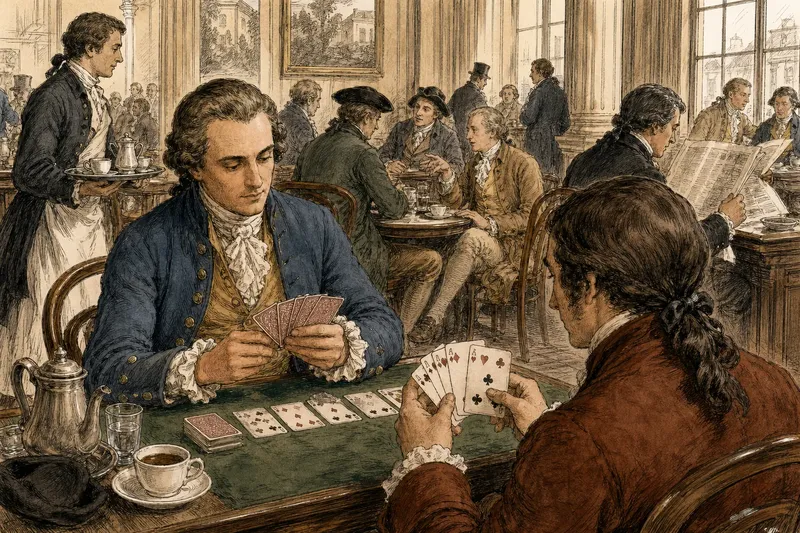
Card games in European coffeehouses shared their tables with conversation, reading and refreshment. The room mattered as much as the rules: unlike a private parlour or a membership club, a coffeehouse could bring players into contact with customers beyond their own circle.
That contrast is useful, but it should not be mistaken for a uniform history. Coffeehouses differed by place and period, as did the people who used them. Looking at the social arrangements around the cards helps explain what each setting made possible without claiming that every venue followed the same pattern.
Coffeehouse card games joined play to public sociability
A coffeehouse offered a place to meet outside a household. Customers might come for refreshment, conversation or other activities, with card play occupying one part of the room’s life. The extent of that mix depended on the establishment and its local customs.
Cards gave a small group a shared activity. Players could take turns while others talked nearby, watched or listened. The game structured attention, but it did not necessarily command the entire room.
Calling a coffeehouse public does not mean that everyone had equal access. Cost, custom, gender, class and local rules could shape who entered or felt welcome. “Public” describes the kind of setting, not universal admission.
Private parlours gathered people through invitation
In a household, the host shaped the gathering. Guests might already know one another, and the room belonged to a private home. That could make play intimate and familiar, while also limiting who could join.
Imagine a household gathering after supper: relatives choose a familiar trick-taking game, and the host decides when to begin and stop. The observable result is a game among invited guests, with the pace and company shaped by the household. It offers a different social arrangement from a room where customers come and go.
A parlour could still host lively conversation, and a household game was not necessarily quiet or inward-looking. The useful distinction is who convened the players and how they came to be together.
Clubs organised play around membership
A club or society could bring members together repeatedly. Its rules of admission and shared identity distinguished it from a coffeehouse serving customers, though the degree of formality varied across groups and periods.
In a club, the relationship between players might precede the game: members met within an established circle. In a coffeehouse, a customer might encounter a table or conversation without belonging to a formal association. These are tendencies to investigate, not fixed rules for every venue.
The comparison is clearest when framed as a question of social access. A parlour gathered invited guests, a club gathered members, and a coffeehouse could accommodate a shifting set of customers. None was free of barriers, and each could include people who knew one another.
Card games shaped the pace of conversation
A game brings turns and pauses. Players attend to their hands, wait for a move and respond; the shared activity can give conversation a rhythm without requiring everyone to talk continuously.
Different rules call for different kinds of attention. A trick-taking game asks players to follow the cards already played, while a less demanding game may leave more room for talk. The balance depends on the rules, the players and the room; there was no single game that defined coffeehouses across Europe.
Card play could mean amusement, competition, social display or gambling, and those purposes could overlap. It is safer to avoid assuming that every game involved stakes—or that none did. The setting could hold several kinds of play, depending on the people and circumstances.
Conversation might range beyond the table, but that possibility does not establish what people said or whether what they heard was accurate. It simply helps explain why a shared room could matter to someone who came for more than a game.
Choose the setting that fits the evidence
When reading an account of historical card play, look first at who gathered, how they met and what the room was used for. The cards alone cannot identify the social setting.
- If the account describes customers coming and going, consider a coffeehouse; if it instead centres on invited guests, consider a parlour.
- If it names a household host, read the game through the household’s control of the gathering; if it describes open customer access, consider a public venue.
- If it stresses recurring members, consider a club; if membership is not mentioned, do not assume one.
- If it describes conversation beyond the players, consider how the wider room shaped the game; if the account focuses only on the table, avoid inferring a broader exchange.
- If it mentions stakes, treat gambling as part of that particular account; if it does not, do not add stakes to the scene.
- If the city or period is specified, keep the interpretation within that context; if either is missing, describe the setting cautiously rather than applying a broad regional label.
Say you are reading an invented account that names a busy city coffeehouse but gives no date, rules or stakes. It describes customers arriving and leaving while two players continue a card game, and mentions conversation at nearby tables. First, note the customer traffic: that supports reading the room as a coffeehouse rather than a private parlour. Next, note the separate conversation: the game did not occupy the whole room. Finally, since the account gives no stakes or precise period, leave gambling and wider historical claims undecided. The resulting interpretation is limited but useful: it shows play alongside public sociability, not a complete picture of the venue.
What is not worth the effort is assigning a fixed social meaning to a game solely from its rules. The same game could appear in different settings; the people, access and purpose of the room provide the more useful clues.
What do readers ask about coffeehouse card games?
Were European coffeehouses mainly places to gamble?
There is no single answer for every place and period. Cards could involve stakes, but play could also serve recreation and sociability alongside other uses of the room.
Who played cards in coffeehouses?
Customers and access varied by establishment and local circumstances. Without a specific account, it is better to describe a changing public than to imply one uniform group of players.
Did coffeehouse card games differ from games at home?
The rules might be the same, while the setting changed the social experience. A public room could bring nearby customers and interruptions; a household game was arranged by a host for invited guests.
Were coffeehouses the same as casinos?
No. A coffeehouse combined refreshment and sociability with activities that could include play; a casino is a more specialised gaming venue. Treating the coffeehouse simply as an early casino obscures the difference in purpose.
The room helps explain what the cards meant
Card games in European coffeehouses belong to the history of how people met as well as how they played. The table organised a small group, while the surrounding room could connect that group to other customers and conversations.
For a particular account, keep the conclusion close to its details: who was present, how they entered the gathering and what else happened in the room. That approach makes the contrast with parlours and clubs clearer without turning varied local histories into one story.