A Near Miss Does Not Make the Next Outcome Due
A near miss can feel like a clue, but it does not make the next outcome more likely. Separate vivid memory from probability and choose calmly.
A near miss does not make the next outcome more likely. In a random game, seeing a result come close to a hoped-for result can stick in memory, but that feeling is not evidence that the odds have shifted.
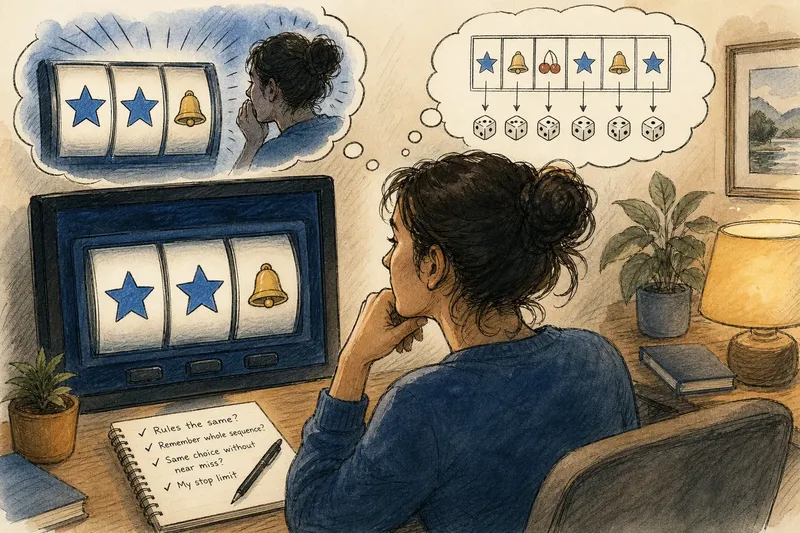
Imagine that Maya is watching a simple digital game in which each round independently displays one of several symbols. She hopes to see a blue star. A round shows two blue stars and then a different symbol in the final position. Maya thinks, “It was nearly there; surely the next one is more likely.” That conclusion feels natural. It is also a mistake about what the previous round can tell her.
Maya’s near miss feels more meaningful than an ordinary result
The almost-complete display gives Maya a vivid scene to remember: two matching symbols, followed by the one that did not arrive. A round showing unrelated symbols would be less striking, so it might fade from memory more quickly.
That difference matters to perception, not necessarily to the game’s probabilities. The near miss can attract attention, invite a story and make the hoped-for result feel close. Yet “close” describes how Maya interprets the display; it does not tell her what will happen in the next round.
People are good at noticing patterns, especially when a result matches what they want or fear. Once Maya has seen the two blue stars, she may watch the next round more intensely and remember it more clearly. The sense that something is building can come from this focused attention rather than from a change in the game.
The next round depends on the game’s actual structure
For a game that produces each round independently under unchanged rules, the prior near miss does not alter the next round’s chances. The game does not “know” that Maya came close, and it has no obligation to complete the pattern.
That does not mean every game works in precisely the same way. A game may use a finite set of pieces, a deck from which cards are removed, or rules that change as play proceeds. In those cases, previous events can affect what remains available. The relevant information is the game’s mechanics, not the emotional force of an almost-result.
In Maya’s imagined digital game, assume each round uses the same independent random process. The blue-star display in one round is then part of the history, not a signal that the next round is due to show it. If the game instead carried symbols forward or changed its available outcomes, she would need to understand those rules before drawing conclusions.
Probability describes chances, not a promise of balance
A common response is that a result must arrive soon because it has not appeared yet. This confuses a long-run pattern with a short-run promise. Random outcomes can cluster, repeat or leave a desired result absent for longer than feels comfortable.
Probability concerns the conditions of the game and the possible outcomes. It does not schedule a particular result after a near miss. Even if outcomes tend to balance out across a large sequence, that broad description does not tell Maya that the next round will repair the previous one.
Memory works differently. It gives extra weight to an event that was vivid, surprising or emotionally charged. Maya may recall the almost-match and overlook several ordinary rounds, then mistake the remembered sequence for a meaningful trend. The memory is real; the inference may not be.
What should Maya ask herself after the near miss?
Did the rules change after that round?
If each round is independent and the rules remain the same, the near miss does not make the desired result more likely next time. If the game has a finite pool or changing state, Maya should consider what the rules say remains available.
Am I remembering the whole sequence?
A striking near miss can eclipse the less memorable rounds around it. Maya can pause and describe what actually happened without turning the sequence into a story about a result being “on its way”.
Would I make the same choice without the near miss?
If the answer is no, the vivid display may be driving her decision more than the game’s rules. She can wait, stop, or continue only for reasons she would still accept without that feeling of momentum.
What would make me stop playing?
Maya can decide in advance what limit suits her time and circumstances, then treat it as a boundary rather than a prediction about when a win should arrive. If gambling is causing distress or financial difficulty, a qualified support service can offer appropriate help.
A calm pause separates observation from expectation
Say Maya has planned to spend a short evening watching the game, not chasing a particular result. After the two blue stars appear, she notices the urge to continue because the display felt close. She pauses, recalls that the next round follows the same independent rules, and checks whether she still wants to watch. If she does, she continues without treating the near miss as a clue; if not, she turns the game off. The observable result is not a particular symbol, but a choice made without relying on a false prediction.
This is the useful distinction: a near miss can be meaningful as a moment in someone’s experience, while carrying no predictive force in an independent random game. Maya need not scold herself for feeling that the result was close. She only needs to avoid confusing that feeling with evidence.
It is not worth trying to decode a sequence of ordinary independent outcomes for hidden signals. A brief pause and a clear understanding of the rules are more useful than replaying the near miss in search of a pattern.
When a near miss comes to mind later, Maya can name it accurately: “That result stood out to me.” Keeping memory in its proper place leaves probability where it belongs—in the game’s mechanics, not in the emotional pull of what almost happened.